Community Clean-Up Success: 50 Tonnes Collected in Hackney
What 50 Tonnes of Rubbish Looks Like
On a grey Saturday morning in November, 200 people showed up to pick litter in Hackney. They collected 50 tonnes of waste in six hours. That is roughly the weight of eight African elephants, which is a comparison nobody asked for but everyone remembers.
The more interesting question is not how much was collected. It is why 200 people voluntarily spent their Saturday picking up other people's rubbish. And whether events like this actually change anything beyond the day itself.
The answers are more nuanced than the feel-good headline suggests. They are also more encouraging.
The Psychology of Showing Up
Most community clean-up events struggle to get 20 people. We got 200. Not because Hackney residents are ten times more civic-minded than average, but because we accidentally triggered three psychological mechanisms that drive collective action.
Social proof came first. We partnered with six local businesses who each committed to sending staff. When the event page showed "47 people going" within the first week, something shifted. People who were vaguely interested saw that others were committed, and vague interest became concrete intention. By the time we hit 100 sign-ups, the remaining 100 came almost without effort. Nothing attracts a crowd like a crowd.
Identity signalling mattered more than altruism. We designed the event materials around the phrase "Hackney takes care of Hackney." That framing made participation about local identity rather than environmental duty. People were not picking up litter to save the planet. They were picking up litter because that is what Hackney people do. The distinction sounds academic. It is the difference between 20 volunteers and 200.
Collective efficacy was the final ingredient. This is the psychological concept that describes a group's shared belief in its ability to achieve a goal. We set a specific, visible target: 50 tonnes. We put up a large board at the staging area showing progress in real time. When the number crossed 30 tonnes by lunchtime, you could feel the energy change. People started texting friends to come down. A shared scoreboard turns individual effort into collective momentum.
What Actually Happens at a Large-Scale Cleanup
The logistics of a 200-person cleanup are genuinely complicated, and nobody talks about this part.
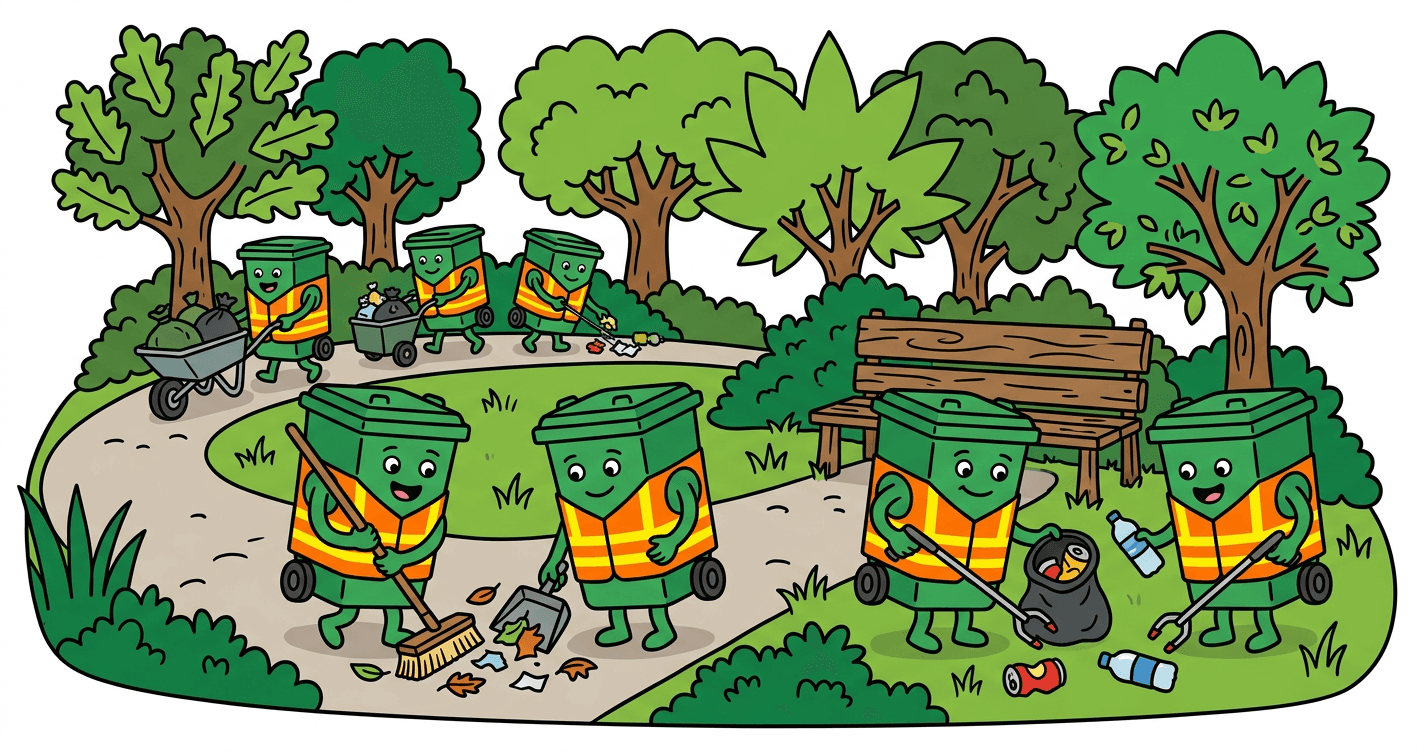
At 7am, five waste.london crew members arrived with three tipper trucks, 500 high-strength refuse sacks, 200 litter pickers, 200 pairs of gloves, and a genuinely heroic quantity of hi-vis vests. We set up eight collection zones across a two-square-mile area, each with a zone captain, a designated waste aggregation point, and a WhatsApp group.
Volunteers arrived between 9 and 10am. Registration took longer than expected because people brought friends who had not signed up, which is a good problem to have. Each person received a brief safety talk, a zone assignment, and a litter picker.
The first hour was chaotic. People clustered in the most visible areas, main streets and park entrances, and ignored the less photogenic spots. By 11am, the zone captains redirected teams to back alleys, canal towpaths, and the edges of housing estates where the real accumulation sat. The places that need cleaning most are always the places nobody wants to photograph.
By 1pm, the aggregation points were overflowing. We called in a fourth truck. By 3pm, we hit the 50-tonne target and the board at staging base confirmed it. Cheering happened. It was not performative.
The Surprising Things We Found
Fifty tonnes of waste contains stories. Not all of them are pleasant.
The single largest category by weight was construction and demolition waste: broken plasterboard, rubble, timber offcuts, tiles. This was not casual littering. Someone had systematically dumped building materials along a section of canal towpath rather than paying for proper disposal. This is textbook fly-tipping, and we reported it to Hackney Council with GPS-tagged photographs.
The second largest category was bulky household items: mattresses, sofas, broken furniture, and an improbable number of office chairs. These sat primarily near bin stores on housing estates where the council bulky waste collection service has a multi-week waiting list. The gap between a person wanting to dispose of a mattress and actually being able to creates a window where fly-tipping becomes the path of least resistance.
Then there were the oddities. A working television. A crate of untouched tinned food with two years of shelf life remaining. Seventeen shopping trolleys from at least four different supermarkets. A fully inflated paddling pool. And, wedged beneath a hedge on Mare Street, a parking meter from the 1990s. We have no explanation for that one.
Why One-Off Events Create Lasting Change
The cynical take on community cleanups is that they are feel-good theatre. The area gets dirty again within weeks. The underlying causes are unchanged. Everyone goes home with a warm glow and nothing structural shifts.
The cynical take is about 60% correct. The area did get dirty again. It always does. But three things happened after the Hackney event that suggest the cynical take misses something important.
First, reporting rates went up. In the four weeks following the cleanup, Hackney Council received a 28% increase in fly-tipping reports from the postcodes we covered. People who had spent a Saturday cleaning their neighbourhood were now noticing and reporting new dumping with a personal investment they did not have before. You care more about mess once you have cleaned it up yourself.
Second, sustained behaviour emerged. We created a WhatsApp group for volunteers, initially just for logistics. Three months later, it has 140 active members who organise informal weekly litter picks in their immediate areas. No branding, no corporate sponsorship, no hi-vis. Just people with bags who now see it as part of their routine. This is the gold standard of behaviour change: when the behaviour persists after the intervention ends.
Third, two local businesses changed their waste practices. A cafe on Kingsland Road and a hardware shop on Mare Street both contacted us after the event to discuss commercial waste contracts. They had seen their own customers at the cleanup and realised that visible waste mismanagement was a reputational risk. Social pressure, it turns out, is a more effective sales tool than any brochure.
What We Would Do Differently
Honesty requires admitting what did not work.
We overestimated how many people would sort waste as they collected it. We provided separate bags for recyclables and general waste, but under time pressure and with gloves on, almost everyone just filled whichever bag was nearest. Next time, we will do post-collection sorting at the aggregation points rather than asking volunteers to sort in the field.
We underestimated water. Two hundred people doing physical work for six hours need a lot more water than we provided. Simple, embarrassing, fixable.
And we failed to collect adequate data on the composition of what was gathered. We weighed everything but categorised too little. For our next event, we are building a simple app that lets zone captains photograph and tag waste as it arrives at aggregation points. Better data means better arguments for infrastructure investment.
The Next One
We are running four more community cleanups in 2026: Tower Hamlets in March, Lewisham in May, Camden in August, and Southwark in October. Each one will be bigger and better instrumented than the last.
If you want to join, the sign-up links are on our website. If you want to sponsor one, even better. But here is the honest pitch: you will spend a Saturday morning in the cold, picking up things you did not drop, in places you would rather not look at too closely. And it will matter more than you expect.
Hackney is cleaner now. Not because we cleaned it, but because 200 people decided that their Saturday was worth spending on a place they share. That decision echoes longer than any truck full of rubbish.
