The Complete Guide to Recycling in London 2026
33 Boroughs, 33 Sets of Rules, One Confused City
London has a recycling problem, and it is not the one you think. It is not that people do not care. Surveys consistently show that over 80% of Londoners want to recycle properly. The problem is that London has made it unreasonably difficult to do so.
There are 33 boroughs in London. Each one sets its own recycling rules. Each one has different bin colours, different collection schedules, different lists of accepted materials, and different opinions on whether a Tetra Pak is recyclable or a personal insult to the waste stream. Move from Hackney to Haringey — a distance of roughly two miles — and you might as well be learning to recycle from scratch.
This is not a system designed for humans. It is a system designed by committee, and it shows.
Why Cognitive Load Kills Recycling Rates
Behavioural science has a concept called cognitive load — the total amount of mental effort required to complete a task. When cognitive load is low, people act. When it is high, people default to the easiest option, which in the case of recycling is throwing everything in the general waste bin and feeling vaguely guilty about it.
London's recycling system is a masterclass in unnecessary cognitive load. Consider what a well-intentioned resident needs to know:
- Which bin does this item go in? (varies by borough)
- Is this item clean enough to recycle? (nobody is quite sure)
- Does the lid go on or off? (depends who you ask)
- What about this black plastic tray? (historically no, but maybe now?)
- When is collection day? (check the council website, which was last updated... optimistically)
Each of these micro-decisions adds friction. And friction is the enemy of good behaviour. Not laziness. Not apathy. Friction.
London's overall recycling rate sits at approximately 33% — well below the national average of 44% and embarrassingly far from cities like Ljubljana (68%) and San Francisco (80%). The infrastructure exists. The willingness exists. What is missing is simplicity.
What Actually Goes Where: The Universal Truths
Despite the borough-by-borough chaos, there are some materials that are almost universally accepted across London. Let us start with what you can be confident about.
Universally Recyclable Across London
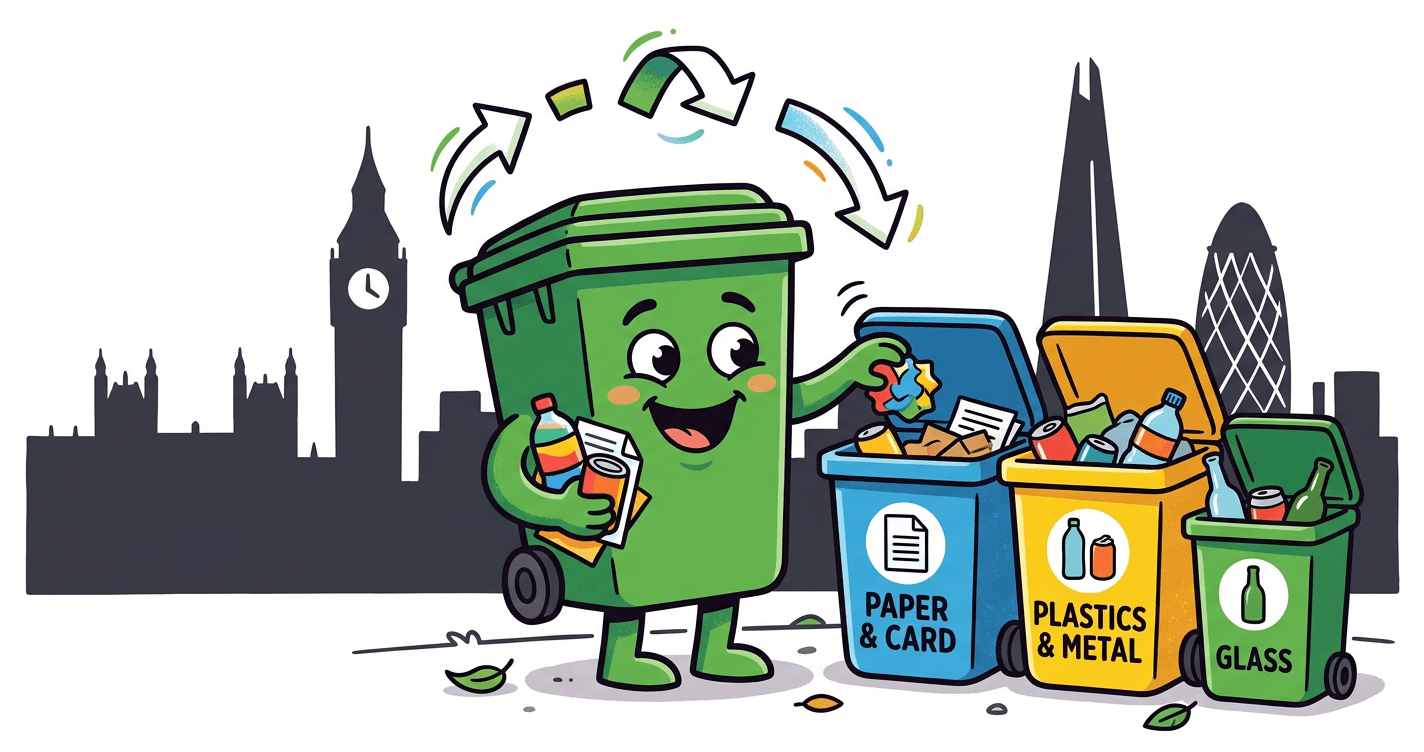
- Paper and cardboard — newspapers, magazines, cardboard boxes, cereal boxes. Flatten them. This is the one thing every borough agrees on.
- Glass bottles and jars — any colour, lids removed. Rinse them. Do not include drinking glasses, Pyrex, or window glass (different melting points, different chemistry, different bin).
- Metal cans and tins — food tins, drink cans, empty aerosols. Rinse food tins. You do not need to remove labels — the recycling process handles that.
- Plastic bottles — water bottles, milk bottles, shampoo bottles. Squash them, replace the lid. Yes, the lids are recyclable now. This changed a few years ago and roughly 60% of Londoners still do not know.
The Grey Areas (Borough-Dependent)
This is where it gets interesting, and by interesting, we mean infuriating:
- Food waste — Most boroughs now offer food waste collection, but not all. Some provide caddies, some expect you to buy your own compostable bags, and at least one borough has instructions so convoluted they read like a legal contract.
- Textiles — Some boroughs collect textiles kerbside. Others direct you to charity shops or textile banks. The answer depends entirely on your postcode.
- Cartons and Tetra Paks — Accepted in roughly 70% of London boroughs. If your borough takes them, they go in the mixed recycling. If not, you are looking at a trip to a recycling centre.
- Plastic pots, tubs, and trays — This is the great plastic controversy of our time. Most boroughs now accept them, but some still do not. Black plastic trays remain problematic in many areas because older sorting technology cannot detect them, though this is gradually improving.
- Small electrical items — A growing number of boroughs offer kerbside collection for small WEEE (batteries, cables, small appliances). Many do not. Check your borough, or use a designated collection point.
Never Recyclable (No Matter What Your Optimism Says)
Some things simply cannot go in the recycling bin, regardless of how recyclable they feel:
- Nappies — No. Never. Not even the "eco" ones.
- Crisp packets and sweet wrappers — Technically recyclable through specialist programmes like Terracycle, but not through kerbside collection.
- Polystyrene — Neither expanded (the white crumbly stuff) nor extruded (takeaway containers). General waste.
- Contaminated pizza boxes — Clean cardboard is recyclable. Grease-soaked cardboard is not. Tear off the clean lid and recycle that; bin the greasy base.
- "Compostable" packaging — This is a genuinely cruel trick played on well-meaning people. Most compostable packaging requires industrial composting facilities, which most London boroughs do not use for kerbside food waste. It goes in general waste unless your borough specifically says otherwise.
The Intention-Action Gap
Here is the uncomfortable part. You probably already knew most of what is written above. The gap between knowing what to recycle and actually doing it consistently is one of the most well-documented phenomena in environmental psychology.
Researchers call it the intention-action gap, and it is enormous. Studies suggest that even among people who describe themselves as committed recyclers, actual compliance rates hover around 50-60%. We recycle when it is easy, skip it when it is not, and systematically overestimate how well we are doing.
The reasons are predictable:
- Convenience trumps conviction. If the recycling bin is further away than the general waste bin, contamination rates spike. This is not a character flaw. It is physics applied to human behaviour.
- Uncertainty leads to "wish-cycling." When people are unsure whether an item is recyclable, roughly 40% will put it in the recycling bin anyway, hoping for the best. This contaminates entire loads.
- Habit formation takes time. New recycling rules take approximately 8-12 weeks to become habitual. Every time your borough changes its rules, the clock resets.
A Borough-by-Borough Survival Strategy
Rather than memorising 33 different rule sets (which nobody has time for, and honestly, life is too short), here is a more practical approach:
-
Download your borough's app or bookmark their waste page. Most London boroughs now have recycling lookup tools where you can search for specific items. Southwark's is particularly good. Wandsworth's tries its best.
-
Learn your collection schedule properly. Set a recurring calendar reminder. This sounds obvious but the number of missed collections in London due to people simply forgetting which day it is remains staggering.
-
Set up a "doubt bin." Keep a small container for items you are unsure about. Look them up once a week in a batch rather than standing at the bin with a yoghurt pot in one hand and your phone in the other, questioning your life choices.
-
Focus on the big four first. Paper, cardboard, glass, and plastic bottles make up roughly 70% of recyclable household waste by weight. Get those right consistently and you are already doing better than most of London.
-
Rinse, do not scrub. A quick rinse under the tap is sufficient. Items do not need to be spotless. The recycling process involves industrial washing. You are not preparing them for a dinner party.
What waste.london Does Differently
We work across all 33 boroughs, which means we have had to learn every single rule set, exception, and quirk in London's recycling landscape. Our collection teams know that Lambeth takes Tetra Paks and Lewisham does not. They know which boroughs want glass separated and which accept it mixed. They know more about London's bin configurations than any group of people probably should.
For our business clients, we simplify recycling into clear, consistent categories regardless of which borough they operate in. Same signage. Same bins. Same rules. Whether you are in Barnet or Bromley, your recycling process looks identical. We handle the borough-specific sorting at our end, so you do not have to.
For residential customers, we offer collection services that take the guesswork out of what goes where. If it is recyclable, we will recycle it. If it is not, we will dispose of it responsibly. No judgement, no confusion, no standing at the bins wondering if this particular shade of plastic is acceptable.
The Honest Truth
London's recycling system will probably remain complicated for years. Standardisation across 33 independently governed boroughs is a political challenge that nobody has solved yet, and the appetite for structural reform is limited when there are potholes to fill and buses to fund.
So the question is not whether the system will get simpler. It is whether you can build habits that work despite the complexity. The answer is yes — but only if you stop trying to be perfect and start trying to be consistent.
Get the big four right. Rinse your containers. Check your borough's rules for the grey areas. And stop putting nappies in the recycling. Please. We are begging you.
