
How London Businesses Can Cut Waste Costs by 40%
The Bill You Never Read
Here is a strange truth about London businesses: most of them can tell you their electricity costs down to the penny, but almost none can tell you what they actually pay for waste. Not the headline number on the invoice — the real cost. The one hiding in plain sight behind contamination charges, overweight fees, and the quiet tragedy of paying for air inside half-empty bins.
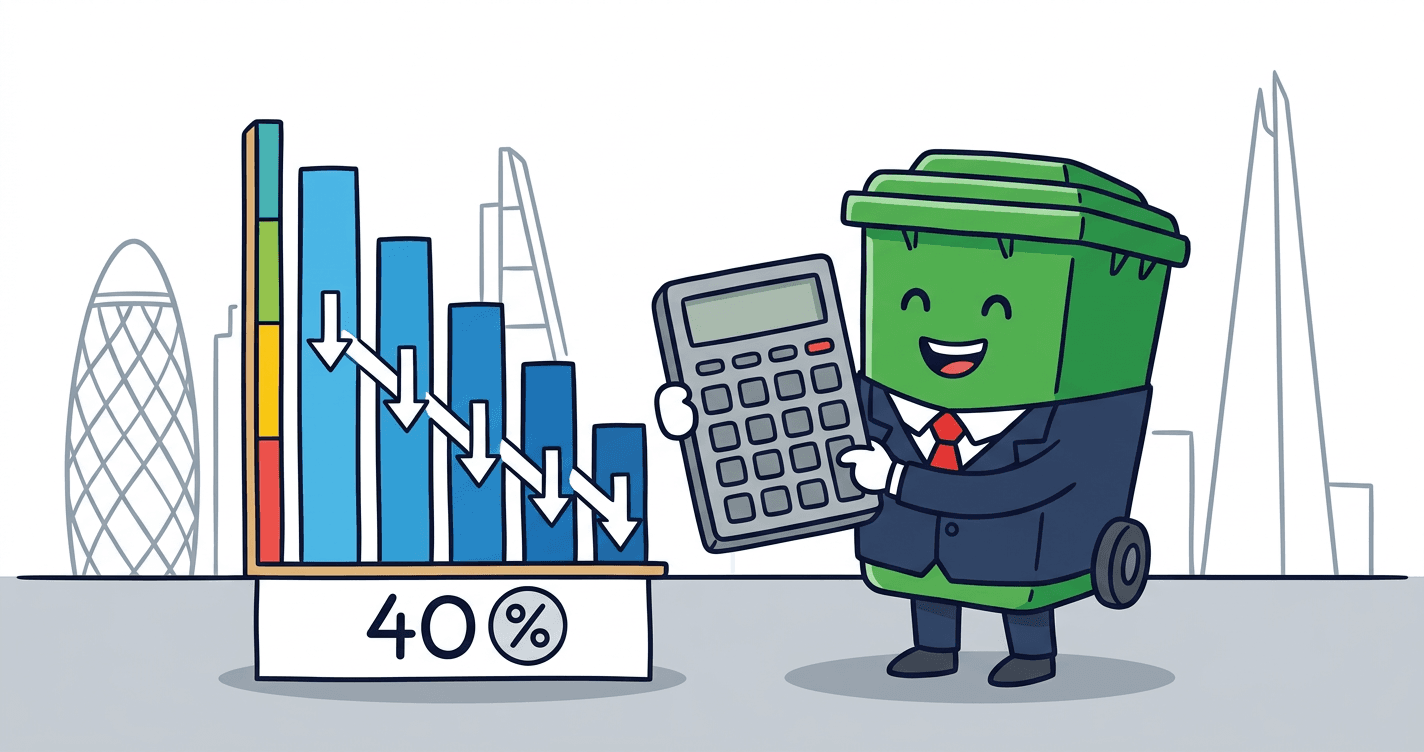
The average London SME overpays for waste by roughly 40%. That is not a typo. And it is not because waste carriers are running some elaborate con. It is because of something far more human: we do not think about waste until it stinks.
Behavioural economists call this the invisible cost fallacy. When a cost is bundled, recurring, and unglamorous, our brains file it under "unavoidable overhead" and move on to more interesting problems. Your waste bill is the direct debit equivalent of background noise.
The Three Invisible Leaks
Most of the money London businesses waste on waste (yes, we are aware of the irony) comes from three sources that are almost comically fixable.
1. Wrong Bin Sizes
This is the big one. A stunning number of businesses in London are running bins that are either too large or too small — and both cost you money.
Too large means you are paying for empty space. A 1,100-litre bin collected twice a week when a 660-litre bin collected once would do the same job costs roughly £2,400 more per year. That is not a rounding error. That is a holiday.
Too small means overflow, side waste, contamination fines, and the special joy of watching your staff play Tetris with bin lids every Tuesday evening. Overflow charges in London typically run £15-£30 per incident, and they add up with the kind of quiet persistence that would make a dripping tap jealous.
The fix is embarrassingly simple: measure your actual waste output for two weeks. Not what you think it is. Not what it was when you signed the contract three years ago. What it actually is, right now, today. Most businesses find their waste volumes have changed significantly since they last looked — which, if we are being honest, was probably never.
2. Contamination Charges
London's contamination rates for commercial recycling hover around 28%, according to WRAP data. That means nearly a third of what goes into recycling bins should not be there. And your waste carrier is not just going to shrug and recycle it anyway. They are going to charge you for the privilege of sorting out your mistakes.
Contamination charges range from £50 to £150 per load in London, depending on your carrier and contract terms. Some businesses absorb these charges for months without even noticing, because they are buried in invoices that nobody reads with the attention they deserve.
The behavioural insight here is status quo bias. Your bins have always had contamination issues. Nobody has complained loudly enough to trigger action. So the charges continue, month after month, like a subscription to a magazine you forgot you signed up for.
The fix: Clear signage (with pictures, not just text — we are visual creatures), a five-minute staff briefing, and one person designated as the "bin champion." Yes, it sounds silly. It works anyway. Businesses that implement basic contamination training see charges drop by 60-75% within the first quarter.
3. Contract Inertia
This one hurts. The average London business has been on the same waste contract for 4.2 years. During that time, the market has shifted, new carriers have entered the space, and pricing has changed substantially. But because switching feels like effort, and the current arrangement feels "fine," nothing happens.
This is textbook loss aversion. The perceived risk of switching (what if the new carrier is worse?) outweighs the guaranteed benefit of saving money. We cling to the familiar even when the familiar is actively picking our pockets.
Here is the counter-intuitive truth: switching waste carriers in London takes about 20 minutes of actual work. The rest is just deciding to do it. Most carriers handle the transition entirely. Your bins get swapped. Your collection schedule continues. The only thing that changes is the number on your invoice.
The Audit That Pays For Itself
A proper waste audit for a London business takes about half a day. It involves counting bins, measuring fill levels, checking contamination, and reviewing your contract terms against current market rates. It is not glamorous work. Nobody has ever posted an Instagram story about their waste audit.
But the return on investment is absurd. For a mid-sized London business (say, 20-50 employees), a waste audit typically identifies £3,000 to £8,000 in annual savings. That is found money. Money that was already leaving your account every month, just quietly enough that nobody noticed.
At waste.london, we run these audits for businesses across every borough. The most common reaction we get when we present the findings is not gratitude — it is mild embarrassment. "We should have done this years ago" is practically our catchphrase at this point.
The Sustainability Bonus
Here is where the story gets genuinely interesting. The strategies that cut waste costs are almost identical to the strategies that improve your sustainability metrics. Smaller bins mean less waste. Better recycling means higher diversion rates. Contract reviews mean finding carriers with better environmental credentials.
London businesses are under increasing pressure to report on sustainability — from customers, from employees, from regulators, and from that one person in accounts who has very strong feelings about single-use coffee cups. Cutting your waste costs and improving your green credentials are not competing priorities. They are the same priority, wearing different hats.
The businesses that have figured this out are not just saving money. They are winning contracts that require sustainability reporting. They are attracting employees who care about working for responsible companies. And they are future-proofing against regulations that are only going to get stricter.
Five Things You Can Do This Week
Because theory is lovely, but action is better:
-
Pull your last three waste invoices and actually read them. Look for contamination charges, overweight fees, and any line items you do not recognise. You will find something. Everyone does.
-
Measure your bin fill levels at collection time. If bins are consistently less than 75% full, you are paying for air. If they are overflowing, you are paying in penalties and frustration.
-
Check your contract end date. If it has already passed and you are on a rolling arrangement, you have negotiating power you are not using.
-
Ask your carrier for a waste composition report. Most will provide one. It tells you exactly what is in your bins, which tells you exactly where you are losing money.
-
Get a quote from at least one other carrier. Not because you are definitely switching, but because knowing the market rate gives you the information you need to negotiate with your current provider.
The Bottom Line
Waste costs are not fixed costs. They are decision costs — the accumulated result of choices made (or more often, not made) about bin sizes, recycling practices, and contract terms. And like all decision costs, they respond dramatically to better decisions.
The 40% figure in our headline is not aspirational. It is the median saving we see when London businesses actually look at their waste spending with fresh eyes. Some save more. A few save less. Almost nobody saves nothing.
The only question is whether the status quo bias wins again, or whether this is the week you finally read that invoice.
waste.london works with businesses across all 33 London boroughs. If you want to find out what your waste is really costing you, we are here to help — no jargon, no long-term commitments, and absolutely no pretending that waste is exciting. It is not. But saving thousands of pounds? That bit is quite good.
