We've Collected 47 Exercise Bikes. No Questions Asked.
Forty-seven exercise bikes. That's our running internal count, tracked informally because it became notable early on. Exercise bikes, rowing machines, and cross-trainers are the most common single-item collection request we receive from London homes, followed closely by unworn formal wear, bread makers, and guitar equipment from someone who took lessons in approximately 2016.
We don't judge any of it. Not because we've been trained to be non-judgmental — because there is genuinely nothing to judge. Accumulation is the most human thing in the world. The psychology that creates it is sophisticated, well-documented, and not a character flaw.
The shame people feel about their clutter is manufactured and counterproductive. It delays the clearing out that would actually improve their lives. It's worth understanding why.
The Psychology of Keeping
People keep things for reasons that seemed rational at the time. Understanding the mechanisms makes the accumulated objects easier to see clearly.
The sunk cost fallacy. You spent £400 on an exercise bike. Getting rid of it feels like admitting the £400 was wasted. So you keep it, turning the sunk £400 into an ongoing cost — space, visual noise, mild guilt every time you walk past it. The economically rational thing is to dispose of the bike the moment you're confident you won't use it. The psychologically difficult thing is exactly the same action.
Optimistic future-self planning. The person who bought the exercise bike was planning for a version of themselves who cycles 4km every morning before work. That person is real and possible. They just haven't shown up yet, and the bike is being kept in case they arrive. This is not stupidity — it's the entirely human tendency to overweight the agency and willpower of our future selves relative to our actual historical behaviour. The future self who will use the bread maker, finish the half-read books, and fit into those trousers again is vivid and compelling. They're just not reliable.
Gift guilt. A significant proportion of the things in people's homes are things that were given to them by people they care about. Getting rid of a gift feels like rejecting the giver. But the object is not the relationship. The relationship exists independently of whether the fondue set is still in the cupboard. Keeping objects out of guilt serves neither the object nor the relationship — it just takes up space and generates a low-level sense of obligation that helps nobody.
What London Homes Actually Accumulate
After thousands of collections across London, the patterns are consistent enough to be near-universal.
Exercise equipment is the headline item, but the volume is in clothing. Studies on clothing habits consistently find that the majority of wardrobes contain items unworn in over a year — by most accounts, 30-40% of the average wardrobe. Not because people don't know they won't wear them — but because disposing of perfectly functional clothing requires a decision and some effort, and daily life doesn't create natural decision points.
Kitchen gadgets are the second category: the items that solved a specific cooking moment (the spiraliser for the week of being healthy, the sandwich press for the year of making packed lunches, the ice cream maker that was used twice). These are not failures — they're experiments that ran their course.
Then there's everything else: the home office equipment from the pandemic rearrangement that was never reassembled, the children's things from stages they've long left, the inherited items that came with a parental home clearance and have been in a spare room ever since waiting for a decision that feels too loaded to make.
None of this is embarrassing. All of it is extremely normal.
Why Professional Disposal Is the Rational Choice
When clearing out becomes a genuine decision, people often underestimate how many barriers exist between intention and action.
The charity shop requires you to assess what they'll take, transport it, and accept the social risk of it being turned away at the door. The council requires advance booking, specific item types, and — increasingly in London — a waiting period. The tip requires a car, a booking, and the physical effort of loading and unloading. The skip requires permits, space, and a minimum volume that makes it economical.
None of these are insurmountable barriers. But together, they create enough friction that clearing out gets deferred — not because people are lazy, but because the logistical overhead exceeds the immediate motivation, which then ebbs.
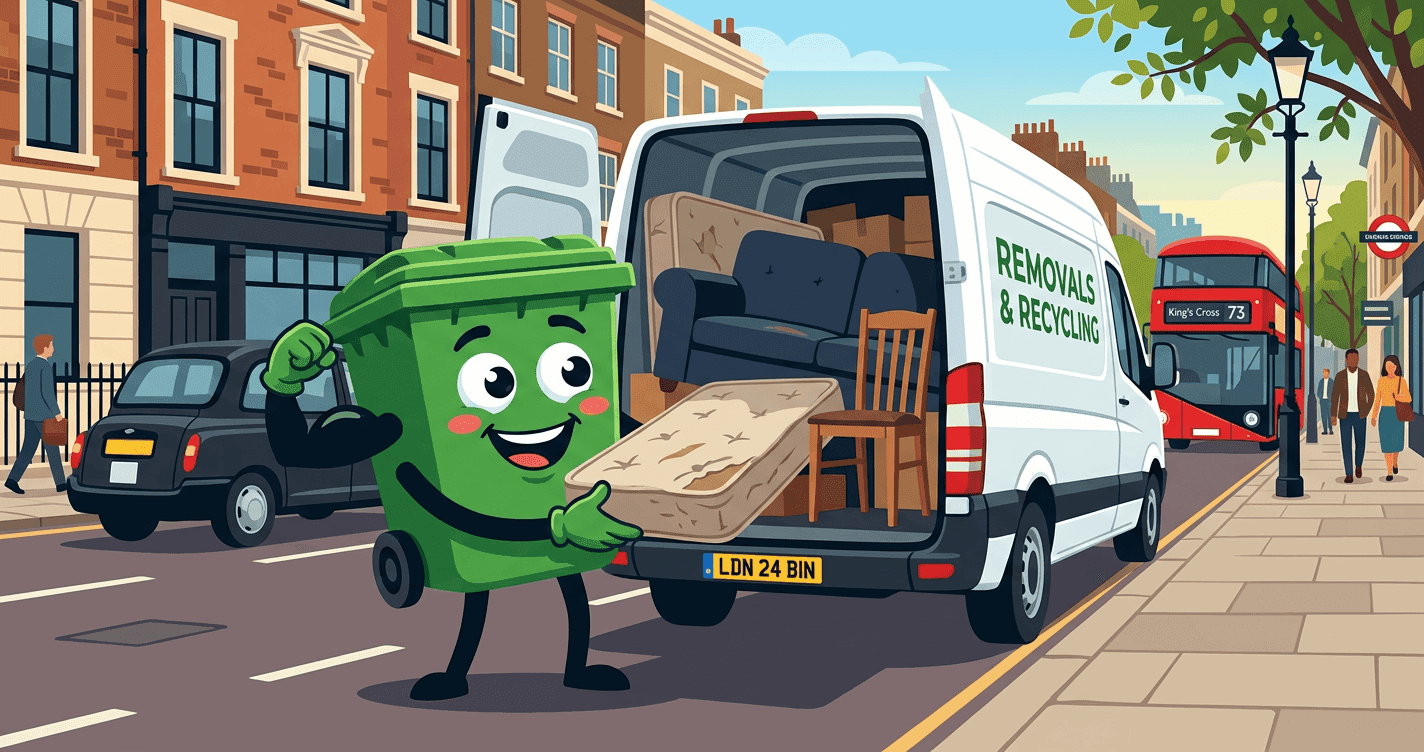
Professional collection removes most of the friction in a single move. We come to you, we take what you're clearing, we sort it for recycling, and the space is clear. There's no trip to the tip, no charity shop rejection, no permit to arrange, no skip sitting in the driveway for a fortnight.
This is also why professional collection is not a luxury purchase for people with too much clutter — it's the most rational way to close the gap between deciding to clear something and actually clearing it. The exercise bike is not valuable to you. The cleared space is. Professional collection is the shortest path between the two.
The Liberation Question
People often report feeling better after clearing out significantly more than they expected to. Not just tidier — actually lighter. The psychological weight of deferred decisions, accumulated guilt, and unresolved sunk costs is real, even when it's not consciously recognised as stress.
There's no ceremony required. No ritual. You don't need to take a photograph of everything or write a reflective journal about what each object meant to you. You just need to let things go, and let someone else handle the logistics.
The forty-seventh exercise bike we collected was in perfectly good condition. The person who called us sounded relieved to be rid of it. They didn't explain why they'd kept it or apologise for calling. They just wanted the space back.
That's the whole thing, really. The space is already yours. You're just making room to use it.
